Saturday, April 21, 2007

Comedy of despair

You drag yourself out of the desert desperate for water, and the barman is busy. But this is not a romantic world. There's not enough Santa Claus to go round. Everyone treats each other with disdain. No one is indispensable. There are mothers of twins who have trouble getting the buggy in and out of shops. Who cares for these? There are people, our contemporaries, lost in libraries through the malice of evil librarians. Who loves these? We are all labouring under a lack of love, a bad situation for human beings. This situation is even bad for CATS.

The biggest threats to life now are leaky radiators, superglue and pre-cooked chicken. When people were dying all over the place (Schubert died just three months after declaring himself healthy), they lived with gusto. They did not waste a brushstroke because they feared death. But now people only die from their own or their doctor's negligence. Convinced of immortality, we're troubled by boredom, an inordinate sense of history and our own fecundity.

Animals have a much harder time of it. The world doesn't owe them a living. But at least they haven't forgotten what it's all about: you, the earth, the sky. Even trees know this.

- Lucy Ellmann, Varying Degrees of Hopelessness

[Varying Degrees of Hopelessness, by Lucy Ellmann, 1991. Love (and the lack of) and sex (and the lack of) at a funhouse-mirror version of the Courtauld Institute in the late 1980s. Talked of as a precursor to the chick-lit boom. Which, in the comic examination of single twenty-and-thirtysomething female lives, it probably is. But it's a hell of a lot odder than that: the anti-naturalism and the brevity, the madly individualistic style, the intensity that is sometimes a deadpan joke and sometimes not, the worrying at the facts of sickness and death - these could be descended from early Beckett. Which is not to accuse Lucy Ellmann of ever writing like anyone else.]

Thursday, April 19, 2007

Rules? What rules?

If you have a goodish memory and you are planning to read China Mieville's Un Lun Dun, you may wish to skip this post. The bit I want to quote is from near the end and the book is extremely plotty. I have redacted some especially spoilerish sentences in the middle of the quote, even at the cost of rather spoiling its effect, but you should consider yourself warned.

The reason I so want to quote it is that it takes aim at a piety of children's fantasy that used to annoy the hell out of me back when I was in the target age-group: the touching final scene where the hero or heroine is informed that, because they have successfully completed their heavily symbolic rite of passage, they must leave the world of the imagination behind, with the compensatory promise of returning to it after death (if this is a Christian-apologetic fantasy) or having lots of sex (if it's a hippy-liberal one).

Mieville's heroine, perhaps because she is small and dark and round-faced and would have been a comic sidekick if destiny had had its way, has an answer:

'The stuff that happened here,' Deeba said, 'I'll never forget. What we did. I'll never forget you. Any of you.' She paused, looked at each of them in turn.

'And part of the reason I won't forget you,' she said, 'is cos I'll be back all the time.'

***

Mortar and the Propheseers - the Suggesters - looked up, startled.

'Come on,' she said, smiling. 'What are you even talking about, Mortar? It's easy to get from London to here [...] People are always going between, and you don't see either universe collapsing, do you?

'You just think it's hard to go between the two cos you've always thought it must be. You're just saying that cos you sort of think you should.'

Deeba's friends stared at her and at each other. 'She has a point,' Mortar said eventually.

[Un Lun Dun, by China Mieville, 2007. Systematic dismantling of the cliches of the children's quest novel, funny but with serious intent, characterisation and narrative drive, set in an alternate London that entails particular thanks to Neil Gaiman in the acknowledgments. It compelled me to read it in a sitting, which is not considerate behaviour in a 500-page book, even one with relatively large print, but is impressive. Author's own illustrations.]

Thursday, April 12, 2007

For those who don't automatically tune in to the Today programme...

...this link should give Alasdair Gray paying tribute to Kurt Vonnegut, who died yesterday. Gray doesn't sound ever so well himself - he may not be a morning person - but he's definitely worth listening to.

London letters 3: Library, Forest Hill

I am away for the next couple of days, so this week's "regular" feature will have to be early instead of late: here is the exuberant eruption of swashes that announces Forest Hill Library (map), and also the confidence once felt by the borough of Lewisham: you are looking at 1900 (August, according to the opening-ceremony plaque), the London County Council newly created but its subdivisions still holding most of the real power.


Underneath, cropped out, is an eighties-looking blue plastic sign that repeats the information in white-and-yellow Futura, either because the council's corporate image must be enforced or because messages become invisible over a certain level of age and ornateness.

Next week I promise to get further from home, and maybe even do some damn research.

Tuesday, April 10, 2007

Trivial inquiry

I just saw someone order "two Americanos" from a place that also, for 70p a cup less, sells filter coffee. Why?

Caffe Americano is an international insult disguised as a beverage. It means "just keep adding hot water to the espresso until it tastes like that filth the Americans drink"; compare (someone else's example) assiette anglaise, which means "well, cold meat is all the English eat, isn't it?"

So, is there a reason to have someone make you a slow, expensive espresso and then try to turn it into a filter coffee, when they could just pour you a filter coffee? My palate for coffee is lousy, so this is a genuine question; for all I know the Americano tastes much better. But it seems more likely that the order would be made on the assumption that nowhere one would want to order serves filter coffee anymore; or that if somewhere does, ordering it would put one outside the circle of civilised people.

Monday, April 09, 2007

Lanchester on copyright

John Lanchester's long article on copyright for this Saturday's Guardian Review was based on a commendably clear and simple principle: that the purpose of the copyright system is to ensure John Lanchester a living. To that end, besides a slinky version of the usual attack on Disney and some personal remarks about the difficulties created by the need for clearance on obscure works, he has two suggestions:

One is that the period of copyright control does not need to be the same as the period during which an artist can earn royalties. I worked for a short while at Penguin in the early 1990s, during which Joyce and Woolf both briefly came out of copyright (on January 1 1992) and sales in their work zoomed upwards, as publishers came out with competing editions - in the case of the one book for which Penguin already had a licence, Ulysses, sales went up (and there were five other editions on the market). As a result of having seen that at first hand, I think that, 50 years after an author's death, anyone should be able to publish a book or record a piece of music or put on a play, as long as they pay a royalty. This would increase general levels of cultural creativity and still allow revenue, but not control, to artists' descendants. We could even have some fun with Mickey Mouse...

The other suggestion is that artists should be guaranteed, by law, a percentage of the revenue from the sale of their work. At the moment, the big retailers squeeze the publishers, who in turn squeeze the talent, so that it is common for as little as 5% of the purchase price of a book, say - though it's not just books - to reach the writer. That's 95% of the money going to someone other than the creator: does that seem right? My experience of asking people about this suggests, very unscientifically, that most people aren't aware that three-for-twos and dramatically reduced prices mean that the writer is earning a smaller royalty per copy.

The suggestions cut against the prevailing legal tendency to make intellectual property behave more like other sorts of property - cutting against that is fine by me - but they also cut against each other. What percentage of the royalties from Family Romance would go, by law, to the author of the anonymous poem that can be quoted only in its English edition?

The risk of reproducing potentially copyright material, as I (poorly) understand it, isn't just that the author's grandchild can decide to have your book pulped; it's that they can present you with a bill of unpredictable and possibly profit-destroying size. To make the first suggestion work in a way that made use of orphan works easier, you'd have to set some kind of standard rate, and then set up an agency to distribute the cash, adjudicate on claims, and - if you believe that the owners of un-orphaned works should be able to demand more than agency rate - decide who's an orphan and who isn't.

Then once someone's successfully claimed the cash for an orphan work, it has presumably ceased to be an orphan. Can they negotiate a higher fee for the next edition? Or stop it coming out at all?

I'd like these kinds of tweaks to work - at the least the first one, if it worked, might have a relatively high chance of happening. But copyright is almost certainly more broken than that.

Friday, April 06, 2007

A world without Borders

Borders has never meant all that much to me as a bookshop. In the early stages, at least, of the chain's UK operation, if your town was big enough to have a Borders it was big enough to have somewhere three times better. But if it does disappear - there's talk of a management buy-out - I'll miss it hugely.

This isn't because of the pious, we-need-retail-variety argument, although that's true. There are two main reasons.

The first is that Borders open late, which is unorthodox for British bookshops, and very useful. If you want a "third place" (ick) at 8pm that isn't a pub or a restaurant, it's going to be Borders. Get stood up at a pub - doesn't have to be a date; it can be a friend struggling with work or public transport - and you* get through several drinks, while feeling increasingly freakish. Your prize is a tincture of tipsy self-hatred and a complete set of smokelogged clothes. Get stood up at Borders and you browse the books, read all the sane bits of this month's Atlantic, maybe buy a coffee in remorse. Your prize is a head full of the not-quite-higher journalism and possibly a latte moustache. You will still smell however you normally smell. I will miss being stood up in Borders.

The second thing, already hinted at, is that Borders is the best chain newsagent in Britain by the length of Charing Cross Road. This week's Press Gazette has a double-spread of independent magazines in panic at the thought that the main outlet that cares about them might disappear. Borders stocks British magazines that our own lovely newsagents couldn't give a bugger about. There are a lot of those. I remember when I was first trying to make myself a proper smartarse, about 1996, the epic struggle it was to buy even mainstream political and literary periodicals (the New Statesman, the LRB) in Nottingham. WH Smith was no help. There was one shop with a serious range - Briddocks, which was a tiny place full of spinners bearing the names of long-defunct hi-fi magazines, and turned out not to be long for this world itself. It might have them if you arrived early enough in the week. Heaven help you if you ended up in a town you didn't know, and had to find the one newsagent behind the many identical frontages that considered it worthwhile to stock the TLS.

Borders has all that stuff as a matter of course, plus all the British stuff I didn't then know about, plus a huge range of systematic US imports - which might disappear even if the UK management can get their buy-out together. They have provoked a lot of other bookshops to take magazines a bit more seriously - I think Waterstone's had some before the Borders threat appeared, but it made them bring in more; Blackwell's and Foyles have both sprouted groaning magazine shelves - but no one else does it as well. I will miss all that. Badly.

*Yes, all right, me.

London letters 2: Dead shops, Elephant

For the second in my new self-indulgent visual series - yes, you're right, I should be on to the third, but I forgot - we go from Edwardian to a 60s/70s "eclectic" style that includes fake Edwardian; an altogether sadder class of period detail.

This aggressively cheery lettering appears on the corner of a first-floor parade of shops in the Heygate Estate, off Brandon Street, Elephant and Castle. The Heygate was completed in 1974 and, if all goes to plan, will be demolished by 2009. The Evening Standard listed it last year as one of London's ten worst architectural horrors, describing it as the "prime example of a failed Seventies estate".

I imagine there's still a terrifying launderette in there somewhere, but I don't know if there was ever a butcher - the signage looks as if it could have come straight from a 1960s artist's impression. It certainly no longer reflects what's on the parade: a school of martial arts, a couple of council or council-and-police-and-probation-service offices, and one of those idealistic probably-doomed community cafes that parades like this tend to attract.

Could be worse, then. Probably has been. But still, depending on your temperament, either heart-breaking or blood-boiling.

Update: I cycled past here again the other day, and I had remembered the shops a bit wrong. It goes: martial arts school, storefront church, "Elephant Enterprises" (not sure what that is, but it doesn't appear to be the kind of shop that opens on Saturdays), Youth Inclusion Project, Heygate Cafe. There is more non-council life there than I allowed. But there are still none of the neighbourhood shops that the architects appear to have envisaged for their street in the sky.

Skyline questions

Those who complain that the scale of the Westminster skyline has been outraged by the high-rise interlopers ignore the fact that cold measurements or even hotly angry ones are not everything - not necessarily anything much. What could dwarf that marvellous monster the Victoria tower, but something of its own kind?

When Barry reared his Neo-Gothic palace against the Abbey, the traditional ruler of the Westminster skies for so many centuries, that was true audacity. Both survive as mighty presences, the real abbey and that newer Nightmare Abbey of genius, ruling the scene unmoved by the lofty impotent giants surrounding it. Nothing much counts for much, or intrudes much. The Festival Hall complex, so alluring by night, fades by day into a range of concrete barns: almost a modern agricultural aspect, a Harvest Festival Hall. Next to it the vast inert face of the Shell building expresses total absence. But Wren's surviving churches, however small, refuse to be extinguished. They ignore monsters; they spike the scene like exlamation marks, commanding attention. And wherever you happen to be sailing or driving or walking, whether you are as near as Southwark or as far as Greenwich, St Paul's pops up all over the skyline like a floating bubble nobody can burst. If it had been anchored in a vista, as its creator intended, that dome would never have had the same capricious and buoyant appeal.

- Norman Shrapnel, A View of the Thames

This is 1977, and Norman Shrapnel assumes his readers will be "on the side of sensible planning", "the most careful and tenacious of co-ordinated schemes". The world that he is gently writing against was already disappearing, but he isn't to know that.

In 2007, those bubblings-up of St Paul's are "protected vistas" - we need planning to protect the appearance of serendipity. I'm not sure what the moral is, except that conventional wisdom is more fluid than it can sometimes seem. We go on making mistakes, but not always the same ones.

[A view of the Thames, by Norman Shrapnel, London, 1977. Late-career ruminations by a former parliamentary sketchwriter of the Guardian, in a lovely version of the paper's old C.E Montague-derived heightened colloquial style. Less deep-thinking than the creaminess of the prose would suggest, but it gives a nice picture of the docklands between death and redevelopment, and an engaging selection of the river's urban myths. The picture, incidentally, is the City seen from the ramp down to the debating chamber in City Hall; the pre-20th-century element seems pretty effectively expunged from that particular vista.]

Thursday, April 05, 2007

Reading, cooking, thinking, cooking

What remains, for a couple of days, the current New Yorker contains a characteristically elegant thing by Adam Gopnik on recipes in novels. It has some lovely solipsistic digressions:

A devotion to shell beans, I have noticed, divides even amateur cooks from non-cooks more absolutely than any other food, and they are, into the bargain, a perfect model of writing. Like sentences, shell beans are a great deal more trouble to produce than anyone who isn’t producing them knows.

But its central argument seems to me flawed. Gopnik's case is that many modern novels have their characters cook at length "to represent the background of thought", in the way that (his examples) walking is used in many Victorian novels, or driving in John Updike. He thinks this is a swizz, because...

...the act of cooking is an escape from consciousness - the nearest thing that the non-spiritual modern man and woman have to Zen meditation; its effect is to reduce us to a state of absolute awareness, where we are here now of necessity. You can’t cook with the news on and still listen to it, any more than you can write with the news on and still listen to it. You can cook with music, or talk radio, on, and drift in and out. What you can’t do is think and cook, because cooking takes the place of thought.

He demonstrates by cooking recipes from several contemporary novels, reserving his politest and deadliest scorn for Henry Perowne "idly" cooking a fish stew in Ian McEwan's Saturday: "You can’t idly make a bouillabaisse while you brood on modern life any more than you can idly make a cassoulet; these are nerve-wracking concoctions."

Probably true. But it's not true, in this bad cook's view, that all cookery demands a disengagement from thought; and even if it was, cooking from fictional recipes would be a particularly faulty way to show it. Ruminating characters tend to be making something they cook routinely, for themselves or a forgiving family audience; Adam Gopnik is trying out new recipes for the benefit, going by one aside, of a "gang".

I can't cook something that I have to think about and think about something else - an audience and a recipe are the two things most likely to push a dish into this category - but if I'm cooking one of the half-dozen things I can do by heart, for myself or for friends with time on their hands, and I'm not at one of a few critical moments, then the process can open up some marvellous space for thought. The best description of the condition is by Primo Levi, in The Periodic Table, when he explains why he finds the process of distillation beautiful:

First of all, because it is a slow, philosophic, and silent occupation, which keeps you busy but gives you time to think of other things, somewhat like riding a bike.

He is engaged, you'll notice, in what amounts to a particularly precise and formalised version of cooking. And he's right about cycling, too.

Monday, March 26, 2007

Oxford links

I'm going to have to buy Isolarion, by the looks of it. I want to read more contemporary fiction, really I do, but I keep being tempted away. Incidentally, any Americans tempted up the Cowley Road by that Bookforum review should bear in mind that "From a penny to a thousand pounds" is a traditional slogan, not anything like an accurate description of the pricing at the Hi-Lo Jamaican Eating House: all the (very good) main dishes cost about the same (£8 or so, last time I was there, six years ago). Try to avoid being seated by the speakers and you'll be fine.

Also, while in town: this and this are cryingly envy-making.

Friday, March 23, 2007

London letters 1: Doorstep, Forest Hill


This is the first in what improvident ambition says will be a regular Friday photo series: the aim is to seek out interesting bits of lettering on London streets, with a particular relish for stuff that might otherwise be overlooked, and attempt to provide a little historical background.

Our first exhibit is the doorstep of what's now a Red Cross charity shop at 6 London Road in Forest Hill. I've chosen it because it's a splendid bit of Edwardian flim-flam, and because it has a lesson for the many people currently writing about the Death of the English High Street. The tendency when looking at an old photograph, or leafing through an old street directory, is to assume that businesses you haven't heard of are plucky little independents. Not much danger of that with Sainsbury's, which is still the third-largest supermarket group in Britain. According to the firm's fearsomely detailed if excessively twee virtual museum, this branch would have been part of a large-ish London "high-class provisions" chain when it opened; it's not on their list of branches open by 1900, and there were "more than 100" by 1903. Chains and supermarkets may indeed be throttling our high streets; it really would be nice to have a planning system that did more to encourage varied and independent shops; but multiples have existed for a long time, and writing as if they haven't will make you sound like Peter Ackroyd in London: The Biography surveying the modern Fetter Lane:

In the stretch of Fetter Lane which leads directly out of Fleet Street, with, on the respective corners, a bookshop and a computer supplier, is Clifford's Inn, the oldest Inn of Chancery and once the most important edifice in the street. Rebuilt now, and partitioned into offices and apartments, it is situated beside a modern restaurant, the Cafe Rouge, and opposite a new drinking establishment called the Hogshead.

It's a distinctive style, but unless you can match Ackroyd's torrential erudition - he goes on to link this stretch of road to John Wesley, Tom Paine, Keir Hardie, Dryden, Charles Lamb, Samuel Butler, Lemuel Gulliver, Virginia Woolf and "the only cross-eyed statue in London" - probably not one to copy.

(The statue is of John Wilkes, and went up in 1988: here's the PMSA record and photograph.)

Tuesday, March 20, 2007

The Baghdad dawn chorus

There's probably only a couple of days left to download the first episode of the World Service's Eyewitness Iraq (BBC things have a tendency to disappear after seven days, and it's taken me several days to find this one on the website). The programme is a boiling-down of Hugh Sykes's reports from the early days of the conflict, part of the four-year-anniversary ruminations occurring everywhere. What makes it particularly worth listening to, however, is a ten-second edit of 40 minutes of early morning in Baghdad, not long after the Saddam statue came down, with the birdsong and the bangs both intensified to dreamlike levels. It gives an extraordinarily powerful sense of how it might feel to have violence become a constant part of your life's background; one of the most effective pieces of wordless radio I've heard.

Monday, March 19, 2007

The old rules

The following is from "Taboo: what newspapermen can never, never say", by Nicholas Tomalin, published in Punch in 1973 and republished in the posthumous Nicholas Tomalin Reporting two years later. It was probably ceasing to be true by the time it was written, but it may be suggestive about how hard it would be to restore a culture of "positive" commentary:

The final taboo that really irks me is the still lamentably general rule that all newspaper writers must be optimistic. 'Upbeat' is the word used. In a strict sense, an upbeat is of course the unimportant hiccup before the musical bar line; it is the down-beat that makes the important statemen. The word has become peculiarly corrupted to mean some tone of voice that makes readers cheerful, and more liable to buy advertisers' products. It means always looking on the bright side. I consider the effect of this taboo is quite disastrous on the national life. Because every second-rate hack knows he must be 'upbeat', and every advertising slogan is upbeating perpetually, anyone with a spark of intelligence comes to feel happiness is a totally unacceptable, vulgar, lying emotion (...) I am quite incapable of saying how utterly wonderful it is to be going onward and upward with ths great country of ours (even when I feel it), because so many idiots are saying so, so very often and so very insistently.

Probably not intended to damn by faint praise

"The audience had been standing in line for an hour. Only a few of them were dressed as Greek hoplites. They were much better balanced between men and women than I’d expected..." -- Neal Stephenson attends a showing of 300 for the New York Times op-ed page. Via Jenny Davidson, who was convinced.

Film haiku

Now that I finally have a home broadband connection, and I no longer have to keep quiet about them, you can have these: 27 haiku that appeared as the "What's on" film listing in the Nottingham Evening Post, one week in October. I put them through without linebreaks, and no one (readers, unwarned editors) appeared to notice anything odd.

ACCEPTED! (12A)
Reject fakes uni,
and then real students turn up.
No reason you should.

THE ARYAN COUPLE (12A)
Hi, Mr Himmler
- no, of course we're not Jewish.
Well, not in public...

BARNYARD (PG)
Think Animal Farm
remade as cheery kids' toon.
Our verdict next week.

BROTHERS OF THE HEAD (18)
Conjoined twin punk stars
rock convincing mock doc, but
where's their character?

CARS (PG)
Pixar motors through
yet another hit cartoon
(yes, that's Paul Newman).

CHILDREN OF MEN (15)
Clive Owen seeks hope
in a grim, childless London.
Stylish Cuaron job.

CLICK (15)
Remote control rules
Adam Sandler's so-called life.
Please, just turn it off.

THE DEPARTED (18)
Cop double-cross finds
Scorsese and Nicholson
true to their talents.

THE DEVIL WEARS PRADA (PG)
Vile ed Meryl Streep
tempts that nice Anne Hathaway.
Sharp as Savile Row.

ECHO PARK LA (15)
Coming-of-age job
in Spanish-language US:
trailers, but no trash.

EVERYONE STARES: THE POLICE INSIDE OUT (15)
Sting's lot get own film.
And it's shot by their drummer.
So "inside" is right.

THE GUARDIAN (12A)
Not the newspaper:
this is coastguard derring-do.
Our verdict next week.

HOODWINKED (U)
Red Riding Hoodlum
tangles with storybook police force.
But it ain't Shrek.

LADY IN THE WATER (PG)
Mermaid seeks writer,
while M Night Shyamalan
seeks a plot, in vain.

LITTLE MAN (12A)
Marlon Wayans poses
as toddler to steal giant gem.
Childish? You don't say...

LITTLE MISS SUNSHINE (15)
Strong cast do wonders
in ensemble road movie.
A beauty, for sure.

ONE LOVE (12A)
Jamaican take
on Romeo and Juliet:
reggae v gospel.

THE QUEEN (12A)
Yay Helen Mirren:
she's truly regal in this
Diana death tale.

STORMBREAKER (PG)
Junior Bond flops
- but he may grow up better,
if we still let him.

TEXAS CHAINSAW MASSACRE: THE BEGINNING (18)
Prequel to remake.
As Hollywood eats itself,
it wants cannibals.

TIDELAND (15) A lost child's strange world
- count on Terry Gilliam
to make it stranger.

TOP GUN (12A)
Shiny young Tom Cruise
flies off to superstardom.
You had to be there.

TALLADEGA NIGHTS (12A)
Top-class Will Ferrell
stars in racetrack comedy.
Ali G steals it.

AN UNFINISHED LIFE (12A)
J-Lo as lone mum.
Well, at least the story's drab.
Sadly unconvincing.

VAUGHAN WILLIAMS ON FILM
England's composer
in two rare archival gems
- both old TV shows.

WORLD TRADE CENTER (12A)
9/11 courage
- and no shortage of bombast -
from Oliver Stone.

Thursday, March 15, 2007

The thing about Penge

If you go around telling people you live in Sydenham, as I have had to do these past few weeks, you often enough end up talking about Penge, down the road. Sydenham isn't much of a topic, whereas Penge has a sort of inverse glamour. It may be something to do with Robert Rankin (I'm told) or Rumpole's "Penge bungalow murders", or the name being carried through town on the front of the 176 bus; more likely it's just the comedy of the sound, and the tinge of dull suburbia it now carries. Looking in Russ Willey's Chambers London Gazetteer (which also reminded me about Rumpole) it appears that Penge is "one of the few Celtic place names in London, and suggests the survival of a British contingent after Anglo-Saxon colonisation". The sense of grimly hanging on has hung on: it's now, going by its Chambers entry, the roughest end of a relatively posh borough (Bromley) having had the rough end of the Crystal Palace building boom. This is the magnificently sneery write-up it gets in James Thorne's Handbook to the Environs of London (1876):

Fifty years ago Penge was only spoken of as a common, and the maps show hardly a house upon it (...) Then "the plague of building lighted upon it;" spread more rapidly when Penge Place was taken for the Crystal Palace, Penge Woods was partly absorbed in the palace grounds, and the rest, doubly attractive from its proximity to that popular resort, given over to the builder; and culminated when a Freehold Building Society bought what had been spared of the Common for distribution among its members. Now, Penge is a town in size and population, in appearance a waste of modern tenements, mean, monotonous and wearisome. It has 3 churches, many chapels, schools, hotels, "offices" of all sorts, shops, 4 or 5 rly. stations, and whatever may be looked for in a new suburban rly. town.

I suspect that last sentence is less than half praise.

Jamesians

Slate has decided to provide a high-profile home for Clive James's webcam interviews, which is excellent news, and to launch them with an extravagant editor's appreciation:

Whether we know it or not, one of the chief inspirations for our ongoing efforts to provoke thought and mirth at the same time is none other than this polymathic Australian extrovert. The kind of television coverage Troy Patterson writes in Slate grows almost directly out of the column James wrote for the London Observer beginning in the 1970s. The quick-witted cultural writing to which we aspire owes its tone to James' essays, first collected in The Metropolitan Critic.

That seems a bit much. Clive James was better than anyone before or since at turning the TV review into a blast of highbrow comedy, but he wasn't first with the idea. Bernard Levin, of all people, used to do it in the Manchester Guardian of the 1950s, where the ground was prepared for him by a once-famous tradition of needlessly witty and erudite music-hall reviewing. And although I admire James's reviewing, I can't shake the accusation in Jonathan Raban's For Love and Money that he writes a dialect "as recognisable as Mummerset; at once donnish high-falutin' and come-off-it low slang, it is the received standard accent of the smart English book review".

But Jacob Weisberg is right to wonder why the man is not more prominent in America; he is as widely cultured a good talker as Christopher Hitchens, treading much of the same literary territory, and better at reading closely (as if that matters). I suppose it's to do with the primacy of politics over culture, Hitchens being a political writer deriving status from his cultural hinterland and James a cultural critic aiming for a political edge. And then Hitchens's old socialist-among-liberals schtick would be more of more use to American talk-show bookers than the liberal-among-socialists one that drives most of James's more political stuff. That James's jokes are for laughing at, rather than admiring as sallies of wit, and that he puts so much work into looking laid back, probably do their share of damage too.

Wednesday, March 14, 2007

Revised and updated

"In all of the more than 700 places reviewed within this guide you should be able to get two courses (starter + main or main + dessert), plus half a bottle of house wine (or a couple of beers) plus service (we've assumed ten per cent when it is not automatically added) for no more than £20 per person." -- Time Out Cheap Eats In London, edition three.

"In all of the more than 500 places reviewed within this guide you should be able to get two courses (starter + main or main + dessert), plus half a bottle of house wine (or a couple of beers) plus service (we've assumed ten per cent when it is not automatically added) for no more than £20 per person." -- Time Out Cheap Eats In London, edition four.

Emphases, conveniently enough, in originals.

[Time Out Cheap Eats In London, edition four, 2007. This is the only guidebook I buy every time it comes out, but it has fallen upon evil days. Not only is the new one 50 pages and 200 entries shorter, it has developed a tendency to seek out posh sandwich shops. These will generally let you pick up a sandwich, a banana ("main + dessert") and a can of organic fake Coke ("a couple of soft drinks") for less than £20, but even in London they wouldn't fit most people's definition of "cheap". On the other hand, it's more sensibly organised -- it has all the maps gathered at the back, rather than sprinkled unpredictably through -- and it seems to have somewhat better coverage of outer London, even if it does file its one Forest Hill recommendation under Deptford.]

Your New Yorker links may no longer work...

...but at least the "Not found" message is beautiful. (This joke stolen from a commenter at kottke.org, via a link emailed from a friend.)

The site has had a mostly handsome redesign; it also inserts cartoons into the text, reproducing the authentic New Yorker experience of pausing in the middle of 10,000 words on female circumcision to smile at a cat saying something Upper East Side. (That joke stolen from another friend the other weekend. It's originality day here.)

Tuesday, March 13, 2007

Presbyterian bean salad

"Since supper was three kinds of casserole with two kinds of fruit salad, with cake and pie for dessert, I gathered that my flock, who lambaste life's problems with food items of just this kind, had heard an alarm. There was even a bean salad, which to me looked distinctly Presbyterian, so anxiety had overspilled its denominational vessel. You'd have thought I'd died. We saved it for lunch." - the Rev John Ames, 76, recovers from a health wobble in Marilynne Robinson's Gilead.

[Gilead, by Marilynne Robinson, 2005. Astonishingly graceful novel in the form of an old pastor's letter to his young son, with a plot that develops so gently that I was a third of the way through before I realised there was going to be one. It ends up gripping. Its pulpit topics - death, love, redemption, forgiveness - are the obvious basis for praise, and you could extract 80 pages of good epigrams from its 280 pages. But it's the convincingness of John Ames's voice, and the solidity of his 1950s Iowa setting, which make the goodness palatable.]

The years of cholera

Sometimes, a book can transform your view of some other book without so much as a direct reference. One of the first things this blog did, back when it still seemed possible that I might finish Macaulay's History of England, was to mock this statement of optimism:

The difference in salubrity between the London of the nineteenth century and the London of the seventeenth century is very far greater than the difference between London in an ordinary year and London in a year of cholera.

Thanks to Steven Johnson's The Ghost Map, I now know that I greatly underestimated the chutzpah involved. A "year of cholera" was not some immemorial curse. When Macaulay was born, in 1800, cholera was a disease that England heard of only when it devastated a British garrison in India. While he was studying at Trinity College, it was building a bridge of corpses across Europe. And while he was a new MP fighting for Reform...

In 1831, an outbreak tore through a handful of ships harboured in the river Medway, about thirty miles from London. Cases inland didn't appear until October of that year, in the northeast town of Sunderland, beginning with a William Sproat, the first Englishman to perish of cholera on his home soil. On February 8 of the following year, a Londoner named John James became the first to die in the city. By the outbreak's end, in 1833, the dead in England and Wales would number above 20,000. After that first explosion, the disease flared up every few years, dispathcing a few hundred souls to an early grave, and then go underground again. But the long-term trend was not an encouraging one. The epidemic of 1848-1849 would consume 50,000 lives in England and Wales.

As it happens, 1848-1849 is the period during which the first volumes of the History of England were published. That puts Macaulay's cheerfulness on a whole different level, no?

[The Ghost Map, by Steven Johnson, 2006. An old-fashioned story of scientific endeavour - empirical good sense and local knowledge, in the form of John Snow studying a Soho cholera outbreak, defeat fifth-hand argument from authority - made into something rather different by the author's determination to tell his tale at every scale from the microbial to the world-historical. His call for a "history of mistakes" (in this case, the mistake is the miasma theory of disease transmission that made cholera so difficult to understand) is somewhat undermined by his breezy and doubt-free way of throwing around currently fashionable ideas; this is not a book for anybody allergic to pat evolutionary psychology. But his confidence in digressing gives The Ghost Map most of its charm.]

Update: Tweaking the labels on this site I realise, somewhat embarrassedly, that I've come across part of this point before, barely a month after reading the Macaulay; I even gave it the same title. Oops. This latest version of the revelation is probably more startling, however; I don't think I previously realised that cholera was arriving for the first time, or how closely its rise could be seen to follow Macaulay's.

Thursday, February 22, 2007

The road and the pavement

The first time I moved to London I read Jonathan Raban's Soft City, a brilliant hymn to urban disorientation and weirdness. It fitted. In fact it fitted so well that it was uncomfortable to read it on buses: I felt that I was looking into my fellow passengers' minds, which was creepy, and that I was offering them the means to look into mine, which was terrifying.

A month ago I moved to London for a third time - difficulties in getting a phone line sorted account for this blog's deadness since - and have ended up reading Jane Jacobs's The Death and Life of Great American Cities. Among other virtues, it turns out to the Raban's anti-book: a hymn to the self-sustaining, self-ordering power of busy areas. He looks at the nearest main road and sees a malevolent river-god (see the link above for quote); she looks at the bustle on the pavement and sees a ballet. What makes it attractive, beyond the sunniness of her outlook, is the quality of her observation. Consider this, on how a good street can police itself:

The incident that attracted my attention was a suppressed struggle going on between a man and a little girl of eight or nine years old. The man seemed to be trying to get the girl to go with him. By turns he was directing a cajoling attention to her, and then assuming an air of nonchalance. The girl was making herself rigid, as children do when they resist, against the wall of one of the tenements across the street.

As I watched from our second-floor window, making up my mind how to intervene if it seemed advisable, I saw it was not going to be necessary. From the butcher shop beneath the tenement had emerged the woman who, with her husband, runs the shop; she was standing within earshot of the man, her arms folded and a look of determination on her face. Joe Cornacchia, who with his sons-in-law keeps the delicatessen, emerged about the same moment and stood solidly to the other side. Several heads poked out of the tenement windows above, one was withdrawn quickly and its owner reappeared a moment later in a doorway behind the man. Two men from the bar next to the butcher shop came to the doorway and waited. On my side of the street, I saw that the locksmith, the fruit man and the laundry proprietor had all come out of their shops and that the scene was also being surveyed from a number of windows besides ours. Nobody was going to allow a little girl to be dragged off, even if nobody knew who she was.

I am sorry - sorry purely for dramatic purposes - to have to report that the little girl turned out to be the man's daughter.

I'm sure other people could give you subtler or more rigorous versions, or refutations, of the "eyes on the street" theory that anecdote supports. Some of them would tell a similar story. But if there's any of them who would notice and describe the girl "making herself rigid", please tell me, because I want to read them.

Given the news around here at the moment, it feels good to be reading a case that cities are not necessarily places of terror; that they can be uniquely civilised, and civilising. My bit of south London (more or less as predicted) has managed occasionally to remind me of one of Jacobs's good scenes, rather than her bad ones. I just wish I could be more optimistic about conditions a borough boundary north.

Thursday, November 23, 2006

Notes on the tweaked Times

It has taken me four-and-a-half days to get my thoughts together on this one, which in blog terms might as well be never, but it's worth looking at some of the ways The Times may have learned from the Guardian redesign. The wedge serifs on its new headline font, Times Modern, are coincidence: we have it from the designer that the inspiration is an old Times titlepiece, and you can see the family resemblance. (All these links, by the way, are from the excellent Newsdesigner and its commenters -- go there for an overview of what's been done, and links to the official Times explanations.) But consider these:

The top one is the Guardian, the bottom one The Times. Now, lots of papers are trying to give their readers more summary information on stories, and more 'entry points' for reading - but settling on a pair of double-line subheads in the first column, separated by hairline rules, and with extra space under the second line in each one, seems a bit too coincidental. It's not a theft or any kind of misdemeanour, but it does suggest that the Times redesigners, Research Studios, read the Guardian pretty closely.

The next case shows more divergence:

This is one of the little breakers the G now uses to lift text-heavy pages, next to one of the grey boxes the T is putting to similar purposes. The T's are bigger and more flexible and less inclined to appear in the middle of text, which suggests they're the result of shared pressures rather than direct inspiration.

The third case is actually trumpeted in the T's description of its new style -- greater differentiation for comment bits on news pages:

Again, G followed by T. Ragged-right text for comment, once a G eccentricity, seems to be becoming an industry standard: the T is going about it much more beefily, however, adding bold to the text and using a radically different headline type rather than just a slightly lighter one. The result looks like something out of the G from before its latest redesign -- except that it used to use serif headlines on comment and sans on news, whereas the T follows the opposite policy.

The G, then, continues to wield design influence beyond what its circulation performance would lead you to expect. (That may be because so many designer types read it, rather than because of simple merit.)

General T redesign verdict? I quite liked the tabloid as it was; this wouldn't put me off, and has the potential to draw me in to pages I'd previously have skipped. The feel is a tad more conventionally tabloid, though, because busier and, in places, more tightly spaced -- not sure they've fully compensated for the bigger X-height of the new headline font, especially in single-line headings.

Hats at war

George Orwell, as previously mentioned here, made the threat of the reappearance of the top hat -- portending the reappearance also of pre-war snobbery, Tory government and mass unemployment -- a running joke in his "As I Please" columns. Max Beerbohm, over in England from Rapello for the duration of the conflict, turns out to have had the equal and opposite thought. Here is Orwell, responding in October 1944 to a rote expression of conservatism in a writers' correspondence course:

I had the same feeling that the pre-war world is back upon us as I had a little while ago when, through the window of some chambers in the Temple, I watched somebody -- with great care and evident pleasure in the process -- polishing a top hat.

And here is Beerbohm, in 1940, mourning for an earlier lost world -- the London before 1910, when Piccadilly was crowded with fascinating horse-drawn carriages, rather than terrifying motor cars, and the artistic rebels in Chelsea had a proper respect for medieval precedent, and his crustiness was only a young man's act:

Perhaps after the present war the top hat will never reappear at any function whatsoever, even on the head of the oldest man. Perhaps it will be used as a flower-pot in the home, filled with earth and nourishing the bulb of a hyacinth or other domestic flower. I hope, in the goodness of my heart, the housemaid will not handle it untenderly, and will brush it the right way. For it is very sensitive. Its sensibility was one of its great charms. It alone among hats had a sort of soul. If one treated it well, one wasn't sure that it didn't love one. It wasn't as expressive as one's dog, yet it had an air of quiet devotion and humble comradeship. It had also, like one's cat, a great dignity of its own. And it was a creature of many moods. On dull cloudy days itself was dull, but when the sun was brightly shining, it became radiant. If it was out in a downpour of rain, without an umbrella, it suffered greatly: it was afflicted with a sort of black and blue rash, most distressing to behold, and had to be nursed back to health with tender and unremitting care. Nature herself was the best nurse, however, during the early stages of the malady. The patient was best left to grow quite dry by action of the air, before being ever so gently brushed with the softest of brushes. Gradually it became convalescent, and seemed to smile up at you while it was rubbed slowly with a piece of silk. And anon it was well enough to be ironed...

I don't say the man at the Temple had been out in the rain. But I'd like to think that's what he was thinking.

[Mainly on the Air, by Max Beerbohm, 1946. The once-famous war broadcasts, with a once-famous note apologising for the infelicities of his spoken style: "I would therefore take the liberty of advising you to read these broadcasts aloud to yourself -- or to ask some friend to read them aloud to you." Imagining his toying with the radio audience ("I am, in fact, a genuine Cockney (as you will already have guessed from my accent)") turns out to be one of the big pleasures of the book; by the later talks he is taking off announcers' quirks, and gesturing sarcastically towards the next programme as if he were John Peel on Home Truths. The ironic humour of his grumpy-old-man schtick is sometimes strained by the completeness of his grumpiness, but the context must have been transforming. John Updike, in Assorted Prose, talks of the broadcasts as a symbol of blitz stoicism. Max could moan about about "ferro-concrete" buildings without so much as acknowledging they were at that moment being bombed into ferro-concrete dust.]

Transition

I've bought a stack of old Pevsner guides in honour of the fact that I am likely to be moving in the next couple of months. It seems a considerable step from Notts -- opening sentence: "Neither the architectural nor the picturesque traveller would place Nottinghamshire in his first dozen or so of English counties" -- to London, which merits two fat volumes even on its 1950s boundaries and under 1950s Pevsnerian asperity.

The best way to narrow the tread may be to live in Lewisham -- opening sentence: "A large borough, but little to see, and nothing of first-class importance." That would make for better reading, too: Pevsner's sniffs of disapproval please me more than his catalogues of approbation.

Lewisham is honoured with two further section-opening insults. "The borough has been singularly unlucky in its architects", under "Public Buildings", is not at all singular -- in casual browsing, I am yet to come across a town hall Pevsner likes -- but the opening of the "Perambulation" is no-nonsense even for him: "There is so little of note that it is hardly worth working out an elaborate itinerary."

[The Buildings of England: Nottinghamshire, by Nikolaus Pevsner, 1951; London Except the Cities of London and Westminster, Pevsner, 1952; London: The Cities of London and Westminster, Pevsner revised by Bridget Cherry, 1973. Not to be assessed in one shot, at least by me; hated by most people with favourite buildings, particularly of a Victorian kind (he dismisses one of mine in Nottingham with two words: "fancifully ignorant"); full of dry amusement.]

Saturday, November 18, 2006

Where was I?

London, and away from computers I felt safe blogging on. Sorry for the gap in transmission. In any case, it turns out that the Glorious Revolution doesn't have much to say about the arrival of a Democratic Congress, unless you count this:

The amity of the Whigs and Tories had not survived the peril which had produced it. On several occasions, during the Prince's march from the West, dissension had appeared among his followers. While the event of his enterprise was doubtful, that dissension had, by his skilful management, been easily quieted. But from the day on which he entered Saint James's palace in triumph, such management could no longer be practised. His victory, by relieving the nation from the strong dread of Popish tyranny, had deprived him of half his power.

Our text remains Chapter 10 of Macaulay's History of England; who gets to be William III -- and who you accuse of being James II -- are questions left to the reader.

Monday, November 06, 2006

Sors Vergiliana, Nov 6

"It was on a Sunday, during the time of public worship, that he was conveyed under a guard to the place of his confinement: but even rigid Puritans forgot the sanctity of the day. The churches poured forth their congregatons as the torturer passed by, and the noise of threats, execrations, and screams of hatred accompanied him to the gate of his prison." -- Macaulay, History of England, Chapter Ten.

The official rules of the game are here. I'm not really playing it, preferring the less rigorous exercise of making a note when a few sentences in what I'm reading anyway happen to chime with the day's news. This technique has worked once before in three years, so perhaps I should abandon random retrospective commentary in favour of proper Vergilian prediction.

On the other hand, we're in the middle of the Glorious Revolution here in the History of England. Lord M. is gathering the constitutional convention that will set out the Bill of Rights. I'd like to think he'll come up with something to match the mid-terms -- or rather that the mid-terms will come up with something to match him.

Sunday, November 05, 2006

More "just got a camera" nonsense

Here are two key cliches of Nottingham amateur photography -- sunsets and the castle -- held together in a single hastily cropped frame. I like it because it's mine. You don't have to, of course.

Ask a fictional journalist

Minor characters from old novels guide you along the bleeding edge of blue-sky thinking. Episode two in what, at this rate, might actually be a series. Episode one and rules of the game here.

This week: Press baron George Roads on the role of editorial judgment in decision-making. No questions needed; he speaks far too well for himself:

You mark up the daily net sales of your paper -- on a curve -- a diagram thing. And then, some time when sales seem pretty average, you try a new feature -- 'Turf notes and notions,' or 'Books that have Pep,' or that thing we're trying out now in The Day -- 'The Bread of Life: the Christian's Daily Crumb.' You keep it up every day for a fortnight and watch the curve on the chart. Then you drop that feature for a fortnight; then you put it on again; and all the time you keep on watching your sales on the chart. The chart may show nothing at all -- the feature hasn't mattered a damn, either way. But now and then the curve goes up a little bit during the second week of the fortnight the feature is in, and down again during the second week of the fortnight it's out. Then you may -- though it isn't sure yet -- have yourself a winner; so you feel round a bit more, just to eliminate possible causes of error. And then, when at last you've got a dead cert, you back it, all in, like a man. Science and guts -- that's all there is to it. Simply keep your hand on the pulse of the nation.

Taken from chapter five of Rough Justice, by C.E. Montague (1926). Compare Yahoo's homepage redesign process. For an earlier appearance of Roads, and notes on where he came from, go here.

Friday, November 03, 2006

Two depressing thoughts for the weekend

From David Remnick's Reporting (£6.99 in hardback from the bookshop below), Philip Roth's entertainingly precise sketch of literature's route to hell in a handcart:

"Every year, seventy readers die and only two are replaced. That's a very easy way to visualise it," Roth said. By "readers", he said, he means people who read serious books seriously and consistently. The evidence "is everywhere that the literary era has come to an end," he said. "The evidence is the culture, the evidence is the society, the evidence is the screen, the progression from the movie screen to the television screen to the computer. There's only so much time, so much room, and there are so many habits of mind that can determine how people use the free time they have. Literature takes a habit of mind that has disappeared. It requires silence, some form of isolation, and sustained concentration in the presence of an enigmatic thing. It is difficult to come to grips with a mature, intelligent, adult novel. It is difficult to know what to make of literature. That's why I say stupid things are said about it, because unless people are well trained they don't know quite what to make of it."

And, via Obscene Desserts, a fragment of Iraq news from The Times that reads like the grimmer parts of Ryszard Kapuscinski's African reporting:

The morgue classifies victims according to their injuries; if a victim has been beheaded, he is a Shi’ite killed by Sunnis. If he has been killed by a power drill to the head, he is a Sunni murdered by Shi’ites. Most victims have been tortured. Bodies are dumped by the roadside and lie there for hours.

J Carter Wood couldn't find anything to say after that, and nor can I.

Service announcement

I have fiddled around with Blogger's new "Layout" system, and as a result this blog now has categories (see sidebar). They show that I read less fiction than I'd like to believe, wander around the margins of politics more than I thought I did, and spend way too much time picking nits. All of these were probably obvious to anyone else.

Sunday, October 29, 2006

Explanation required

From my nearest bookshop, a strange little remainders specialist:

Is this supposed to be some sort of display? Is there a short member of staff who gets dangerously cranky when denied instant access to high shelves? Is it a conceptual art project? Or is it just an attempt to look lovably eccentric? If the last, it's succeeding.

Saturday, October 28, 2006

Typographical balloon animals

They're what your life is missing. Really.

[Via]

Ask a fictional journalist

Let minor characters from Victorian and Edwardian novels guide you through the bleeding-edge world of new media. A new series! One that may have more than one part! Interviews are conducted on a Wired speak to Rockefeller basis, not a Zembla speak to Henry James one: that is, I am decontextualising quotes, not attempting to use my imagination. Opinions may be selected for resemblence either to conventional wisdom or actual wisdom, cuts may be concealed without remorse and quality of transcription may, as ever, be crap.

This week's interviewee is Mr. John Rorrison, the sole Fleet Street contact of the hero of J.M. Barrie's When a Man's Single. Rorrison is certainly probably possibly "practically editing a great London newspaper". He explains How to succeed in blogging.

Rorrison, I've got this great new political blog. Will you link to it?

You beginners seem to be able to write nothing but your views on politics, and your reflections on art, and your theories of life, which you sometimes think original. Readers don't want it.

I know what this is about. You only link to your powerful mates, right?

Don't believe what one reads. Men fail to get a footing on the press because -- well, as a rule, because they are stupid.

All right, all right. So there are too many of us trying politics.

Yes, and each thinks himself as original as he is profound, though they only have to meet to discover that they repeat each other. The pity of it is that all of them could get on to some extent if they would send in what is wanted.

And what's wanted?

They should write of the things they have seen... readers have an insatiable appetite for knowing how that part of the world lives with which they are not familiar. They want to know how the Norwegians cook their dinners and build their houses and ask each other in marriage.

But I'm in Aberdeen. I'm hardly ever anywhere exotic.

Neither was Shakespeare. There are thousands of articles in Scotland yet. You must know a good deal about the Scottish weavers -- well, there are articles in them. Describe the daily life of a gillie: 'The Gillie at Home' is a promising title.

But TotallyGillie.com must have done all the big topics by now.

Of course they have, but do them in your own way... new publics are always springing up.

So I'm not to write about politics at all?

Write about politics if you will, but don't merely say what you yourself think; rather tell, for instance, what is the political situation in the country parts known to you. That should be more interesting and valuable than your political views.

And what if I don't want to write all this personal bollocks?

If you have the journalistic faculty, you will always be on the look-out for possible articles. The man on this stair would have had an article out of you before he had talked with you as long as I have done. Once I challenged him to write an article on a straw that was sticking out of a sill of my window, and it was one of the most interesting things he ever did. Then there was the box of odds and ends that he promised to store for me when I changed my rooms. He sold the lot to a hawker for a pair of flower-pots, and wrote an article on the transaction. Subsequently he had another article on the flower-pots; and when I appeared to claim my belongings he had a third out of that.

The Grey Lady's light basement*

The New York Times "home page" feed just gave me this intriguing bit of fluff about politicians using hand-sanitiser after long bouts of handshaking. It has some of the falseness of all trend stories: to be news it has to suggest or imply that this quirk of behaviour has just come into being, or just become more prevalent; in fact, the reporter has just noticed it, and decided we might be interested. He's right, though. It is interesting. So fine.

The most interesting thing is that no politician is quoted as santinising to protect the public from their germs, rather than themselves from the public's. Maybe one of them tried that line and was dismissed as a flatterer; but surely they could have been profitably mocked as a flatterer in the text? So maybe they all are that egotistical.

I'd feel more sympathetic if the pols were French. According to a friend who should know, but may have been winding me up, the French cliche equivalent to "kissing babies" for political glad-handing is "feeling cows' arses". (And the key fact about Jacques Chirac, apparently, overlooked outside France, is that he's the greatest cow's-arse feeler in living memory.) Hand sanitisation after that? More than excusable.

*Apologies if this headline was even less comprehensible than usual. I believe a 'light basement' to be a human-interest story put in at the bottom of a broadsheet page; I'm going by a Julian Barnes piece collected in Letters from London, where Simon Jenkins says he insisted on having them as editor of the (London) Times. And the Grey Lady's the other Times, obviously, which having never fully accepted post-1930 conventions of newspaper layout probably finds the equivalent space half-way up a left-hand column, or on page K1 of a special weekly section called "Fluff". Forget I mentioned it.

Monday, October 23, 2006

Fun with juxtaposition

One of the nice features of the Guardian website is the little block of related links it gives you at the end of each piece. But this one seems unfortunate on a story about a man who leaves his own excrement in train carriages:

Monday, October 16, 2006

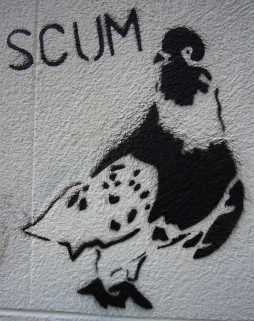
Tom Lehrer does stencil graffiti

...and in a rather swish part of Nottingham, too. For location guide, see here and click on 'aerial' or (better) 'bird's eye view'.

Thursday, October 12, 2006

Adventures in pleading

His lawyer, Joe Tacopina, says of his client, “He’s a genuinely really sweet individual” who “has been demonized because he’s the guy who was cutting off the limbs.”

-- from New York's take on the Alistair Cooke body-snatching scandal, via Jenny Davidson.

Monday, October 09, 2006

Orwell overdose in progress

Reading a book of newspaper columns is like eating a whole bag of boiled sweets. The first one is refreshing. Your taste is whetted. Your juices run. By the tenth or fifteenth your mouth feels stiff with sugar and the flavour is all aftertaste, but some vestige of the original pleasure drives you* on. By the last one you are nauseous, and you get sicker at the very thought of the Fox's polar bear.

Last Wednesday I went to an interesting pub in Fitzrovia, met one of my favourite journalism tutors, and gave him £20. In return he gave me several drinks and the most gigantic bag of barley sugars, concealed under the title Orwell in Tribune. I'm more than halfway through the binge now; so far it's pure "As I Please" - that is, pure George Orwell newspaper miscellany - cut with just one pseudonymous Christmas article. And yet my appetite feels healthier than I could have imagined.

There are some things that start to cloy. The anti-Catholicism gets a bit old - it's not just Spain or even Spain and Beachcomber. The "brain-ticklers" were annoying even in the heavily selected Collected Journalism version. But the accretion of literary personality makes good all irritations. He toys, quietly, with the sort of leftist jargon he is more famous for flaying ("I am objectively anti-Brains Trust, in the sense that I always switch off any radio from which it begins to emerge"). He has an excellent running joke about top hats. And there is a care about epithets, preached and practised, that his admirers at the Daily Telegraph might have to call politically correct. He may enjoy winding up Catholics, but he never calls them Roman Catholics.

From the second "As I Please":

It is an astonishing thing that few journalists, even in the left-wing press, bother to find out which names are and which are not resented by members of other races. The word 'native', which makes any Asiatic boil with rage, and which has been dropped even by British officials in India these ten years past, is flung about all over the place. 'Negro' is habitually penned with a small n, a thing most Negroes resent. One's information about these matters needs to be kept up to date. I have just been carefully going through the proofs of a reprinted book of mine, cutting out the word 'Chinaman' wherever it occurred and subtituting 'Chinese'. The book was published less than a dozen years ago, but in the intervening time 'Chinaman' has become a deadly insult. Even 'Mahomedan' is now beginning to be resented; one should say 'Muslim'.

From the 36th:

Now, it seems to me that you do less harm by dropping bombs on people than by calling them 'Huns'. Obviously one does not want to inflict death and wounds if it can be avoided, but I cannot feel that mere killing is all-important. We shall all be dead in less than a hundred years, and most of us by the sordid horror known as 'natural death'. The truly evil thing is to act in such a way that peaceful life becomes impossible.

'Selective quoting of George Orwell' is not a contest that deserves prizes, but that aspect of him was new to me.

[Orwell in Tribune: 'As I Please' and other writings 1943-7, compiled and edited by Paul Anderson, London, 2006. Oh, just read it. Or just buy it and then read it.]

*I mean me, which is shaming.

A cyclist pays for stereotyping drivers

A suited man in a BMW 3-Series stopped to let me turn right today. I was so confounded I forgot to nod thank-you. The next second, I was nearly kebabbed by the Volvo estate that overtook him.

Thursday, October 05, 2006

National Lampoon conservatism

"Imagine a guillotine, on which a kitten is strapped, connected to a bicycle that must be predalled ever more quickly to keep the blade aloft. Slow down, and the kitten gets it." -- Will Wilkinson of the Cato Institute explains the relationship of happiness to economic growth, in the October issue of British Prospect. If your response is "Free the kitten!", you are presumably some kind of dangerous pinko utopian.

Monday, October 02, 2006

Mixed metaphor of the day

In full, the intro of this morning's Press Association Tory conference story:

Pressure was growing on key planks of David Cameron's reform agenda today amid growing evidence of dissent among the Tory grass-roots.

It would be nice to think someone wrote that for a bet.

Saturday, September 30, 2006

The man they couldn't bar

This morning, someone asked me what I was laughing at. It was The Unfortunates, B.S. Johnson's novel-in-27-unbound-sections on grief and the vagaries of memory. Specifically, the bit that follows. 'Tony' is Tony Tillinghast, the friend whose death from cancer a chance visit to Nottingham has prompted B.S. Johnson to remember. The pub is one near B.S.'s flat in Angel, from which he and his friend Jack had been banned after scribbling obscenities in the 'virginal urinal', smashing the odd pint glass, and so on. A pause of three em spaces in the original is represented here by a paragraph break, because my HTML isn't all that. Anyway:

...Tony suggested going into the pub, on this occasion, it must have been the second time he came to the Angel, not the first, now I think of it, because I had worked at another pub, and I was barred from that one, too, or did not go in there, anyway, or something, but he said Let me go in first and order one for you to come in and drink, after a few minutes. And it worked perfectly, I stood outside and counted a hundred, then went in to him and took up my drink, and they were astounded, confounded, the woman and the barmaid, who were both there, it worked well, they muttered amongst themselves, or together, but there was nothing they could do about it, it was so well timed. But they would no serve us with another drink, I remember asking Why not? very aggressively, and them staring back, angrily, and saying You know why! And I think threatening to call a copper. But we left victorious despite, Tony and I, with some dignity, too, as I remember. The beauty of it was that Tony was so polite, gentlemanly and friendly in buying the drinks, had formed a relationship with them, they being very pleased at new custom in an area where it was not common, I think, and they therefore had this friendliness thrown in their faces, so to speak, but could do nothing about it. Ah, the beauty of that!

And then Tony suggested doing the same thing the next evening, only sending two friends in to set up drinks for four, and then both he and I would walk in, and after that they would surely never serve any drinks to anyone unless they saw who it was first, they would be that unsure that they were not going to see the two fat guys walk in again.

[The Unfortunates, by B.S. Johnson, London, 1969, reprint 1999. More readable and less affecting than I expected, although that may be my shallowness. It is an excellent portrait of what the mind does in a stretch of waste time -- kinships with Nicholson Baker's The Mezzanine, which again I wasn't expecting. The precise observation of Nottingham detail was a pleasure for me, although knowing the geography of his wanderings tugs against the randomness of the form.]

SILLY IDEA BONUS: Thanks to Jonathan Coe's biography of Johnson, we now have a pretty good idea of when The Unfortunates took place: Boxing Day, 1964, when The Observer assigned the author to watch Forest play Spurs. A city that took its literary heritage seriously, rather than just arranging random volumes in the shape of an N, would declare Boxing Day to be B.S. Johnson Day, on the model of Bloomsday, and have hordes of tourists buying quarters of ham from a deli near Old Market Square, drinking two marsalas in Yates's Wine Lodge, and then watching a disappointing Forest match. Of course, in the spirit of the book, you would have to let your visitors do these things in an order of their choosing, or maybe gather at the railway station and then draw lots to decide the schedule. I may write a letter to our tourist authorities, and see how politely they give me the brush-off. And I may then try and do it myself anyway.

Tuesday, September 26, 2006

A Dickensian character

"Charles Chaplin, Charlie, Charlot, the Tramp, the little man, kiss-kiss, was the most important and dynamic figure in the early days of cinema. In defeat and glory, pathos and aplomb, he was an inspiration to many, ammunition for the rest, and someone who never knew boredom with himself. Indeed, following Chaplin's slapstick career, reading the Autobiography that could have been co-written by Micawber and Heep, is to have the sense of someone watching his own show. Surely that is a clue to filmmaking, direction, or whatever: the ability (or the curse) of being in life while directing the act at the same time." -- David Thomson, The Whole Equation.

The purpose of this post was to applaud that 'Micawber and Heep' quip. But I was unable to stop myself typing out the rest of the paragraph, and I reckon my first reading missed the real insight (and insult): "never knew boredom with himself". That really is worth applauding.

[The Whole Equation, by David Thomson, London, 2004. Celluloid's own John Aubrey turns from biography to history, and proves as blessedly idiosyncratic in his new form. This is a four-chapter verdict; I'll be surprised if I'm less happy at the end.]

Monday, September 25, 2006

The insult in history

"The multitude was unable to conceive that a man who, even when sober, was more furious and boastful than others when they were drunk, and who seemed utterly incapable of disguising any emotion, or keeping any secret, could really be a coldhearted, farsighted, scheming sycophant. Yet such a man was Talbot." -- Macaulay, on Richard Talbot, Earl of Tyrconnel. I don't think historians get to write sentences like that any more.

I've just passed another chunk of Macaulay's comments on the Irish in general, and the level of blithe racism is stunning. A man of his time, yadda yadda, but still -- his remarks on the moral evil engendered by eating potatoes must have been particularly welcome at the end of the 1840s.

[A History of England, by Thomas Babington Macaulay, London, 1849 to 1861. Only three-and-a-half volumes to go! I shall press on. I had forgotten the pleasure of reading small, old-fashioned hardbacks on public transport. All your fellow passengers assume it's a Bible. The sympathetic ones conclude you are at your devotions, the unsympathetic fear you might try to convert them -- and either way, you suddenly have personal space.]

Friday, September 22, 2006

Bonus for enduring excuses

While we're in London (see below), please accept as a peace offering The Tomb of the Unknown Yuppie, which gave me a right start when I ran across it. Official title, date and so on here, which is also the source of the photo; all courtesy of here, as ever.

Excuses for absence

The reason there's been nothing here for a few days, over and above the usual laziness, is that I've been away in London in conditions not conducive to blogging.

On the other hand, I have had a chance to catch up with the Evening Standard's 'Save our Small Shops' campaign, which yesterday detected supermarkets making dastardly use of "bargain beer and spirit offers" to crush their rivals. I'm sure it's true. What added intrigue was the choice of examples:

Tesco sold Pavlov vodka for £6.23, but when VAT and excise duties are excluded this is the equivalent of just 17p a bottle. This was half the lowest wholesale price available to other retailers.

A bottle of Tesco value whiskey cost £6.86, or, before taxes, just 36.8p or £4.42 per case of 12.

Tesco Value Whiskey? Yes, they're coming after our winos. For when a corner shop loses the custom of its local alcoholics, how can it go on? You should see the offers Aldi has on meths these days.

'Pavlov' is a marvellous name for a dirt-cheap vodka, though; the kind of detail Martin Amis might once have come up with.

Sunday, September 10, 2006

Hospital canteens and the "duty to protect"

Agnes was gentle and indecisive generally, a dove if ever there was, but had flown out hawkishly over the war. Her brother-in-law had been in his prisons, and, though she would not say what had happened to him there, Agnes thought even war was better than letting such things exist.

But if we remove one tyrant, then why not another, she'd said to Agnes; most of the staff at this hospital could give ample reason for us to go to war with their country of origin - every single one of them, if you asked the cleaners.

True, said Agnes; and maybe that's the way ahead.

-- from "The Phlebotomist's Love Life", in Helen Simpson's collection Constitutional. The driver of the story, and the emotion we're probably meant to identify with, is anti-war rage; but I like the opening up of another option.

Commercial note: On the evidence of Amazon, Constitutional's out in paperback on October 5. I hereby claim to be a month ahead of the curve, rather than eight months behind it.

[Constitutional, by Helen Simpson, London, 2005. Seriously accomplished comic stories. The plots flick round like second-hands, but each has the rest of a clock behind it. Adulterous, au-pair-employing suburban London appears to have literary life in it yet.]

Saturday, September 09, 2006

Disturbance at Weekday Cross

Some time in 2008, Nottingham will have a large and potentially splendid new art gallery. Until then, we have a large hole in the ground. To reconcile us to what's going on - that hole used to be a park - the creators of the gallery are staging a series of sweet little art happenings at the point where the hole meets the street. I am increasingly enchanted. There hasn't been this much fun at this particular crossroads since we got rid of the municipal bear-baiting pit, not to mention the bullring and the stocks.

Here, anyway, is the point -- a relic of today's happening:

The set-up was two women at a slightly dodgy-looking stall: sweets, a raffle box in red smoked plastic, and decorations in the same jeweller-meets-pawn-shop trim you see above. They were offering any quantity of time in exchange for written details of use and price. My year and a day was to hunt a dragon; I offered the traditional half a kingdom plus one hand in marriage. Should a fairy tale enter your life, you have to embrace it properly, no?

(The artists involved were called CoLab, but Google can't find my any more about them; may report back if I manage to get to one of their unveilings.)

Tuesday, September 05, 2006

Origin myth

Two short scenes from David Peace's Clough-at-Leeds novel The Damned Utd. There are three more scenes between them, all in the space of two pages.

First this:

The cleaning lady is cleaning my office, under the desk and behind the door, whistling and humming along to the tunes inside her head --

'You know, I once sacked all the cleaning ladies at Derby.'

'What did you do that for then, Brian?' she asks me.

'For laughing after we lost.'

'Least you had a good reason then,' she says. 'Not like Mr Revie.'

'What do you mean?'

'Well,' she says, 'Mr Revie once sacked a lass here for wearing green.'

'Wearing green?'

'Oh yes,' she says. 'He thought green brought bad luck to club.'

'And so he sacked her?'

'Oh yes,' she says again. 'After we lost FA Cup final to Sunderland.'

'Just like that?'

'Yes,' she says. 'Just like that.'

The telephone starts to ring. I pick it up. I tell them, 'Not now.'

Then this:

I have been in the kit room. I have been among the socks and the straps, the shirts and the shorts, but I have found what I was looking for. I have changed out of my good suit and nice tie into my tracksuit bottoms and this old Leeds United goalkeeping jersey.

Down the corridors. Round the corners. Through the doors and into the car park. The team and their trainers are already sat on the bus waiting for me. I climb aboard and plonk myself down next to Syd Owen at the front of the coach --

'What do you think of this then, Sydney?' I ask him.

'Of what?'

'Of this?' I ask him again, pointing at this old Leeds United goalkeeping jersey.

'I think if the team have to wear suits when they travel, so should their manager.'

'But what do you think of the colour, Sydney?'

'Green?' he asks. 'I think it suits you, Mr Clough.'

You'd call that cinematic, except the final reveal would be extremely difficult to do on screen. The writing has other hidden sophistications, too: I hadn't noticed the cleaning lady's dropped 'the's ("bad luck to club", "After we lost FA Cup" -- the tic of Yorkshire dialect cliche represents with a "t'") until I had to type her out.

For the significance of that green jersey, if you don't already know, try the picture at the head of this BBC obituary or the logo of the Brian Clough Statue Fund.

[The Damned Utd, by David Peace, Faber, London, 2006. A first-person account of the manager's nightmarish 44 days in charge of Leeds United, the most powerful and hated club in Britain, intercut with a second-person account of the rapid rise that took him there. The structure could be hubris and nemesis, or a reflection of the curse -- "first with gift and then with loss" -- that an unknown Yorkshireman is casting on our anti-hero. Builds an impressive sense of grim inevitability, although that could be something to do with me already knowing what's going to happen. No idea how far from documentary it is, but it feels original and fully imagined.]

Sunday, September 03, 2006

After the war

Macaulay on why the politicians of the Restoration were such Bad Men. Long (I forgot how long -- I'm a hundred or so pages south by now) but sadly unlikely to lose resonance:

Scarcely any rank or profession escaped the infection of the prevailing immorality; but those persons who made politics their business were perhaps the most corrupt part of the corrupt society. For they were exposed, not only to the same noxious influences which affected the nation generally, but also to a taint of a peculiar and of a most malignant kind. Their characters had been formed among frequent and violent revolutions and counter-revolutions. In the course of a few years they had seen the ecclesiastical and civil polity of their country repeatedly changed. They had seen an Episcopal Church persecuting Puritans, a Puritan Church persecuting Episcopalians, and an Episcopal Church persecuting Puritans again. They had seen hereditary monarchy abolished and restored. They had seen the Long Parliament thrice supreme in the state, and thrice dissolved amidst the curses and laughter of millions... One who, in such an age, is determined to attain civil greatness must renounce all thought of consistency. Instead of affecting immobility in the midst of endless mutation, he must always be on the watch for indications of a coming reaction. He must seize the exact moment for deserting a failing cause. Having gone all the lengths with a faction while it was uppermost, he must suddenly extricate himself from it when its difficulties begin, must assail it, must persecute it, must enter on a new career of power and prosperity with new associates. His situation naturally develops in him to the highest degree a peculiar class of abilities and a peculiar class of vices. He becomes quick of observation and fertile of resource. He catches without effort the tone of any sect or party with which he chances to mingle. He discerns the signs of the times with a sagacity which to the multitude appears miraculous, with a sagacity resembling that with which a veteran police officer pursues the faintest indications of crime, or with which a Mohawk warrior follows a track through the woods. But we shall seldom find, in a statesman so trained, integrity, constancy, any of the virtues of the noble family of Truth. He has no faith in any doctrine, no zeal for any cause. He has seen so many old institutions swept away, that he has no reverence for prescription. He has seen so many new institutions, from which much had been expected, prodeuce mere disappointment, that he has no hope of improvement. He sneers alike at those who are anxious to preserve and those who are eager to reform. There is nothing in the state which he could not, without a scruple or a blush, join in defending or in destroying. Fidelity to opinions and to friends seems to him mere dulness and wrong-headedness. Politics, he regards, not as a science of which the object is the happiness of mankind, but as an exciting game of mixed chance and skill, at which a dexterous and a lucky player may win an estate, a coronet, perhaps a crown, and at which one rash move may lead to the loss of fortune or life.

You can choose where you want this applied or argued with according to political taste.

Ian Hamilton on Larkin's afterlife

The Larkin fun in the sidebar here (it points here and here) sent me scurrying back to Ian Hamilton, who I rememembered being good, and angry, on the post-biography change in Larkin's reputation. Sure enough:

A couple of weeks ago, there was a write-up in the Independent about a rap performer name of Ice Cube, author of 'A Bitch is a Bitch' and 'Now I Gotta Wet'cha'. Ice Cube, we were told, is notorious for his misgyny and racism and for whipping up his fans into ecstasies of loathing: he has them 'grooving to a litany of hate'. Only one of Ice Cube's lines was quoted - 'You can't trust no bitch. Who can I trust? Me' - but the reviewer did attempt to pinpoint his subject's characteristic manner of address. He called Ice Cube's language 'incessantly Larkinesque'.

Larkinesque? Did this mean that Ice Cube, for all his appearance of commercialised aggression, was secretly a somewhat poignant type of artist, wry, subtle, elegiac; that his dignified, distressful lyrics were likely to linger in the memory for decades? It seems not. In this context, 'Larkinesque' signified 'foul-mouthed'. And the Independent's readers were supposed to know this. Oh, Larkinesque, they'd think as one, that means Cube uses the word 'fuck' a lot.

And who can blame them if they do so think? After all, in the week before the Ice Cube notice, these same readers were treated to a daily dose of Philip Larkin's more repulsive apercus: sexual intercourse is like having someone else blow your nose, women are stupid, kids should be sent away to orphanages more or less at birth, and all the rest of it. At the bottom on one page, in a little box, we would get the Independent's 'Daily Poem' - usually some workmanlike concoction without a flicker of inspiration or originality - and on another, similarly boxed, there would be the ugly mug of Philip Larkin, together with a line or two of his off-the-cuff plain-speaking. What a busy newspaper: encouraging les jeunes and les no-hopers even as it chips away at the repute of the best poet we have had since Auden.

That's the introduction to a review of the Motion biography. The start of his review of the letters gives one notable reason why fashionable literary London (as the phrase goes) might have turned against Larkin:

There is a story that when William F. Buckley Jr sent a copy of his essays to Norman Mailer, he pencilled a welcoming 'Hi, Norman!' in the Index, next to Mailer's name. A similar tactic might happily have been ventured by the publishers of Philip Larkin's Letters: the book's back pages are going to be well thumbed. 'Hi, Craig', see p. 752, you 'mad sod'; 'Hi, John', see p. 563, you 'arse-faced trendy'; 'Hi, David', see p. 266, you 'deaf cunt', and so on. Less succinct salutations will be discovered by the likes of Donald Davie ('droning out his tosh'), Ted Hughes ('boring old monolith, no good at all - not a single solitary bit of good'), and Anthony Powell, a.k.a. 'the horse-faced dwarf'. There is even a 'Hi, Ian': he calls me 'the Kerensky of poetry'. Not too bad, I thought at first. Alas, though, the book's editor advises me that Larkin almost certainly meant to say Dzerchinsky, or somebody - some murderer - like that.

(It seems the letters were out first, by the way, at least in England.)

But Hamilton does not follow the approach of defending Larkin by attacking his executors. He had written about them sympathetically (in the greatly to be recommended Keepers of the Flame) before the Letters and the life came out. He jibs at Motion's style -- "too solemnly intrusive... The teacher in him is often at war with the narrator and, in the early sections of the book, where he is guessing, he slips easily into an inert biographese"; but he does not cricitise the handling of Larkin's sex life and his primary reactions seem to be shock and (for Larkin) something between anguished empathy and pity, with a dash of irritation. I'm going to take him as my guide, for now.

You see, I've never actually picked up the Motion biography, having heard so much bloody about it. But a good sample of Larkin's hates and rages come through in his poems. We don't have to live with them on the basis that his feelings against women, black people, lefties, rivals, everyone, were first and deepest feelings against himself, although probably they were. We have to live with them because he forged them into poems that are lasting and memorable and touching and draw echoes from us (me, anyway) even of their most shaming admissions. If we can't cope with that, it's our problem -- not his and not even (I suspect) his biographers'.

(The Hamilton reviews quoted appear in the The Trouble with Money, which is apparently still just about in print, and in Walking Possession, which isn't. I'm afraid you still need both.)