Tuesday, August 15, 2006

At long last Loeb

Slate has a late but good addition to the hoopla surrounding the 500th volume in the Loeb Classical Library, the venerable series of Latin and Greek texts with facing translations. Good because the author, Emily Wilson, actually has something amusing to say about Quintillian's Lesser Declamations, with facing translation by H. Shackleton Bailey, and because (not unrelatedly) she's a working classicist with intelligent doubts about the sort of dilletantism the series enables:

I still wonder whether we really should be welcoming these splendid new translations with open arms. I, for one, would be extremely wary of recommending a Loeb in an undergraduate class in which the students were expected to read the original Latin or Greek. The temptation to rely too heavily on the translation would be all the greater now that the translations are so much better than they used to be.

This is surely a decision that makes itself. You don't have to recommend Loebs. Where there are undergraduates expected to read Latin and Greek, there will be at least one bookshop with a wall of the things. Even if your classics department is too small to make your town a Loeb-rich environment, word will get around. Some things are too useful not to hear about. Your students will find them and crib. And if you haven't recommended them, then any moderately conscientious student will crib thoroughly enough to give the impression that they didn't crib.

The worse worry, well expressed higher up the article, is that the Loebs can serve a culture with no place for the more than moderately conscientious. Mastering the crib is as far as you're encouraged to go. Indeed, you may receive a gold star for getting that far. Googling around this point, I found that the Weekly Standard considers Loebs to "certify seriousness". It's the handsome covers that do it, apparently.

Back when I dreamed of being serious about such things, it was the Scriptorum Classicorum Bibliotheca Oxoniensis that certified seriousness: hyper-reliable texts, no English even in the notes, and a cover style that makes a Loeb look modernist. I never managed them. But even a straight English translation was more heavyweight than a Loeb, provided it wasn't a Penguin.

Loeb bonus: Harvard UP's publicists, otherwise pretty hot on this one, seem nonetheless to have missed the 90th birthday of one of Latin literature's most-used cribs: H. Rushton Fairclough's Virgil. Or maybe they're saving the champagne for the second volume's 90th, in two years' time.

Monday, August 14, 2006

Question of the week

"...when did you last enjoy a thriller you thoroughly understood?" -- Michael Wood

Grudging steps towards convention

The New Yorker does not permit itself a masthead listing editorial staff. That would be unconscionably vulgar, and perhaps uncomfortably long. It does now venture a brief collection of notes on contributors, which mainly act as the same sort of status indicator. Result: some of the most sublimely circular and uninformative sentences in print today. From the August 7 and 14 issue, I particularly like...

Sasha Frere-Jones (Pop Music, p. 90) writes the pop-music column for the magazine.

The birth of modern political journalism (with a note on how it might die)

The text of today's sermon, like so many of the others recently, is from C.E. Montague. In this case, A Hind Let Loose (1910), his first novel, a farce about crappy provincial journalism. George Roads, a rising press baron, is talking to an unimportant interlocutor about the town's two newspapers, the Tory Warder and the Liberal Stalwart. I have made a snip in the middle, indicated by three dots.

"Still at it, ain't they?"

"At what?"

"Readying folk to read anything else they can get, to be rid of 'em. Bless you, these old party papers! Party! Good Lord!"

"'Party!' says Burke, 'is-'"

"Burke! I dare say. Some Fenian. Tell you, the thing's played out. Why, look about you; take a business man, average business man. He's got no party; not such a fool. He's fluid, not frozen all up. First this way a bit, then that way a bit - that's him. And d'you tell me he doesn't get up, every morning, fair itching to be rubbed a way no paper in this place has ever rubbed him yet? Kept in touch with - that's what he wants to be."

"What's 'kept in touch with'?"

"Told he's right." Roads' audience grew; his audiences had a way of growing...

"What would you pay," Roads pursued, with a corresponding rise of voice, "to be told, first thing when you got down to breakfast you were drunk last night, or you revoked, or ate with a knife, or something? That's what they call the game, I s'pose, these party papers. Why, look at the last war. Do you folks really want to be told a war's wrong when their blood's up? Or right, a year after, when they're sick of it? That's what they do, between 'em, these papers - blackguard their own customer, turn about; soon as one shift knocks off work at saying the country's a fool, t'other'll come on."

If you detect a pre-echo of the Daily Mail's Iraq policy, you should be warned that "Roads" is not a synonym for Harmsworth; the early career Montague gives him is much closer to the Hulton clan, which would make the half-penny morning paper he's planning the Daily Dispatch. And no one needs to make satirical points against the Daily Dispatch any more.

On the other hand, Roads' reader-frottage approach to editing is the foundation of much modern journalism; papers and writers vary according to who they try to rub. This may be an underestimated driver of newspaper resentment of blogs; it is galling to hear populist rhetoric from writers who can get away with rubbing far smaller groups of people than you. Anyone can be a blogger, true; but good blogs, good political blogs particularly, tend to assume a level of knowledge and a precision of partisanship that no one who needs to appeal to a newspaper-sized audience will dare. Homework assignment: rework the Long Tail thesis to fit what's happening to political writing, bearing in mind that the money's more in the patronage and commissions attracted by blog reputation than it is in AdSense, assuming there's any money at all.

Monday, August 07, 2006

TMS vs OBO

On Sunday, Test Match Special had a series of distressed e-mails from readers who had found themselves seated in the West Stand at Headingley, had discovered that it was neither quiet nor sober, and had come over all Feedback about it.

They followed up by sending a reporter into the stand to interview several families and peaceable spectators -- all of whom said they loved it -- and a couple of pissed men in fancy dress, who expressed an unsurprising enthusiasm for dressing up and getting pissed. Then back to the commentary box, where Jonathan Agnew declared in his most serious voice that both lovers and haters of the stand would now be more convinced.

The next morning’s Guardian over-by-over also discussed the issue. It produced somewhat different findings. First this:

"I saw my first live Test match yesterday and really enjoyed the day," writes Nicky Glover. "The atmosphere was fantastic and I was impressed with the good atmosphere between the English and Pakistan supporters - there was the occasional dodgy chorus of 'Stand up if you wear a dress' which I couldn't help chuckling at - I was just wondering if the Pakistan supporters who were there thought this was a bit of fun/ good natured banter or if they found this offensive?" Well?

Then this:

"I'm Pakistani and was up at the match on Saturday, great day out," says Sayed ZA Shah. "Three of us were the only Pakistanis in the whole West Stand, but the fight between Hulk Hogan, Mr T, the Hulk and David Hasselhoff was one of the finest moments of comic genius I have ever witnessed. Fancy dress day well worth checking out at a Test match."

Lots to be said for both outlets, obviously, but which would you rather have ten pints with?

Death, sex, sandwiches

John Harvey's Resnick novels had proper characters, convincing and involving police-procedure plots, and an acute sense of place. They had, in general, good clean prose. (True, the first page of Rough Treatment has a fat man move with surprising lightness, but what else is a plus-sized burglar to do?) For Nottingham readers, however, they had one other decisive virtue: cafe recommendations. In almost every novel our finicky Polish detective would disappear into some little place in the inner city or the Victoria Centre market. Many of them proved to exist and to be as good as billed.

I've just had my first encounter with the new Harvey series character, Frank Elder -- his second appearance, Ash and Bone. And I must say I was worried. He conducts many of his meetings in Starbucks. But we are saved. There is a cameo appearance for Resnick, with this outcome:

The cafe was French, a small patesserie set back from the main road that ran immediately south from the station. There were a few tables on the pavement, maybe a half-dozen more inside. Bread, criossants, baguettes and a gleaming espresso machine. Two women of a certain age, smartly dressed, sat near the rear window drinking coffee; a silver-haired man, camel coat folded over the back of his chair, was reading Le Monde and eating a croque-monsieur. Elder, who had used St Pancras enough over the years, had no idea it was there...

'How did you know about this?' Elder said, looking round.

'Charlie told me about it.'

I think I know where he's thinking of, and I haven't gone in, and I will.

[Ash and Bone, John Harvey, London, 2005. More thrillerish than the Resnicks -- that's the way the market's going, apparently -- with what seems like a greater number of splashy plots, and more sex. But that could be my faulty memory. The structure resists tidiness nicely, and the social set-up feels more solid and plausible than any policeman-out-of-retirement novel has a right to. I'll be reading the others.]

Sunday, August 06, 2006

Sorry, but this imaginary relationship is doomed

Consecutive adverts in the present LRB personals column:

I celebrated my fortieth birthday last week by cataloguing my collection of bird feeders. Next year I’m hoping for sexual intercourse. And a cake. Join my invite mailing list at box no. 14/04. Man.

No beards. F, 38. Box no. 14/05

Monday, June 12, 2006

How to pass a UK citizenship test

If you can't remember Britain's second emergency number, or the details of employment law w/r/t trade-union membership, you might write this in any space provided for additional information:

I don't give a hang for all the sound intellectual reasons for devotion to a country -- pride in its greatness or its blasted 'rough island story', or the pedigree of its kings. I would as soon love it for its imports of jute. As far as I can tell, my own regard for England is almost wholly sensuous, or at any rate broad-based on something sensuous. My England is the Strand and Waterloo Bridge and all the Thames and the Pennine Hills here, and the crowd at a League football match, and Midland farmers talking like Shallow and Silence about the price of beasts, and the look of the common soldier in France at anything new, and the special kind of good-temper and humour and relenting decency that the man of the working classes has here. It's always something visible or audible or tactible, and there's not a scrap of a sound intellectual reason why I should feel any affection for it, any more than there is why most of us should be loved by our wives. In fact it is love and not judgment or wise criticism, which are much inferior affairs.

That's C.E. Montague again, inevitably, in a letter reproduced in the only full-length biography of him. It's here because I declaimed it aloud to a very knowing American of my acquaintance and he seemed to like it.

[C.E Montague: A Memoir, Oliver Elton, London, 1929. An old-fashioned praise-filled life and letters, always looking for an appropriate place to insert another of the subject's unpublished poems. Impressively thorough, though.]

Service note: Many apologies, dear reader, if you were on while something was triple-posted a few minutes ago. Wireless connection on blink + my stupidity = result you saw. And this blog will get back to quoting something other than journalism and books by old journalists soon, I promise.

Beams, motes

Perfection is for no one, least of all me, but I couldn't help being pleased at this coincidence. Here's the introduction to the sixth edition of the Guardian stylebook on the problems of the fifth edition:

The confusion was typified by the rather wonderful "amok, rather than amuck"; followed, two entries later, by: "amuck, not amok".

And here's two entries, separated only by "homeopathy", in the sixth and the current online version:

homeland
but home town

homepage, hometown
one word

My italics, obviously.

[The Guardian stylebook, David Marsh and Nikki Marshall, London, 2004. Ranks among the newspaper style guides amusing enough to be read for themselves. Not as essayistic or pungent as Waterhouse on Newspaper Style (nee Daily Mirror Style), but more comprehensive, and impressively short on false conventional wisdom.]

Lord Russell, tear down that wall

Simon Jenkins, in Landlords to London (1974), on Bedford Square in Bloomsbury:

The Estate's officers, with the experience of the haphazard development of south Bloomsbury behind them, went to inordinate lengths to ensure that nothing would mar the quality of their new neighbourhood. The conditions imposed by [the Bedford estate's agent Robert] Palmer on the builders went into mind-boggling detail. The proportions were all laid down, as were the quality of materials to be used -- 'best Memel or Riga timber' with floors of 'good yellow seasoned deals free from sap'. No trades were permitted nor was any change of use from residential allowed. Even the lesser streets which were built north of the Square -- Chenies Street and Store Street -- were banned to traders. Servants were expected to patronise the shops south of Great Russell Street, and strict limits were placed on through traffic. Gates guarded the entrances to Bedford Square from the south and Gower Street from the north and a shopkeeper was not even allowed to send his boy to make a delivery. He would only be admitted if he came himself, lest the tone of the neighbourhood should in any way be lowered.

He appends a remark about "the fortified suburbs of Los Angeles", but things have moved on. We have our own super-rich to mock these days.

And a bonus liberal London snobbery quote, did you know the cachet of your postcode depends on the price of a ticket there in 1870?

For the most part South London failed to develop the social prestige attached to the new northern suburbs. Certainly, especially on higher ground, pockets of eminent respectability survived into the twentieth century, for instance in Wimbledon, Dulwich and Blackheath. But none of them exerted on their surrounding estates the economic attaction of a Highgate, a Hornsey, a Hampstead or later of a Harrow or a Wembley Park. One thesis is that the railway companies were stronger to the north and had less need to court suburban traffic with cheap tickets, which in turn tended to drag down the economic tone of a neighbourhood. The LNWR, the Midland and the Great Western absolutely refused to introduce any workmen's fares throughout the nineteenth centur, thus neatly preserving a ninety-degree arc of north-west London from working-class colonisation.

He later uses the inverse -- financial troubles at Liverpool Street, and a resulting rush of cheap tickets -- to explain the "tone" of the Essex suburbs.

[Landlords to London, Simon Jenkins, Constable, 1975. The history of a metropolis considered as one long frenzy of property speculation -- an approach that fits London very well. Some repetition and loose editing, but if it was a 'quickie' book (preface says much of it comes from research for the Evening Standard, which he was about to edit) then it's a remarkably coherent one. His declared purpose -- a memorial to private land speculation, now that London is under the total grip of municipal development power -- is another for the hindsight file.]

Wednesday, May 24, 2006

How the wheel turns

This is the bitterest stroke of satire in 'Owd Yer Tight, Emrys Bryson's 1965 A-Z collage of Nottingham life. It's filed under J, for "Jack - I'm All Right":

"Guardian Journal", June, 1964. - A tumbledown block of five outside lavatories is shared by 18 adults and 19 children in Little John Street. All the nine terraced houses are more than 100 years old and are without bathrooms or even hot water. Every day the occupants have to disinfect the drains in the middle of the yard where children play between the dustbins. They spoke of damp walls, crumbling plaster, pigeons nesting in the attic, falling chimney pots and woodworm. Last year health officials had to be called in to deal with an invasion of cockraoches and ants.

The area is not due for inspection until 1966.

November 19th, 1964. - Mr J.J. Dunnett, Labour MP for Nottingham Central, told the House of Commons that in Central Nottingham alone there were 15,000 houses more than 80 years old which lacked inside sanitation, a fixed bath and a heating system. Six thousand of them not only lacked basic amenties but were so terrible that they had been condemned. Houses were sometimes so terrible that they could not be sold and were being let at rents which were exorbitant - £3 a week instead of 17/2; £4 5s instead of 16/11.

Nottingham has a housing waiting list of 5,340 families.

In 1964 Nottingham Corporation built 508 houses.

In the first six months of 1965 Nottingham Corporation completed 268 houses, and an exactly similar number was provided by private enterprise.

Nottingham is now building at the rate of 750 dwellings a year.

Since April 1945 - over 20 years - the Corporation has built 17,246 houses, a yearly average of 862. There are between 15,000 and 20,000 slum houses in the city.

January, 1965: Nottingham's No. 1 civic car is now a £10,000 Rolls Royce...

Completely justified indignation, of course, although given a sly push in the original by following a series of extracts on Victorian and Edwardian slums. What's sad is knowing that an equivalent work in 1980 would have vented its anger on tower blocks; and that the anger of the sixties would have helped raise them.

['Owd Yer Tight, by Emrys Bryson, staged Nottingham Playhouse 1965, published Nottingham 1967. A pageant-cum-guidebook-cum-scrapbook, almost entirely quotation, that ranges at will over Nottingham's history. Witty and learned and enough to make you nostalgic for the time of its writing, for all the pettinesses and injustices it describes. It's named after "the mating cry of the city's bus conductors" - these have died out, and the tram conductors who eventually came in their place have not taken up the call.]

Balance of coverage

The Google News selections for my home town are usually eccentric, but this morning's was depressingly acute:

Tuesday, May 23, 2006

Pub food, 1961

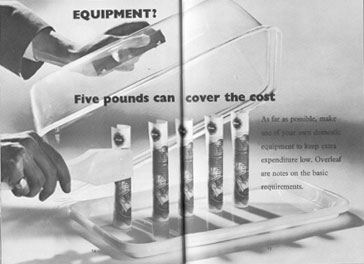
For this blog's inaugural picture, an encouragement to make sandwiches for your husband's pub. This spread is from The Guinness Guide to Profitable Snacks, a handsome hardback book apparently given away inside the trade. It eventually ended up in my surviving local secondhand shop. They manage to fit 11 bottles or glasses of Guinness into a compact cover image, but the inside is scrupulously soft sell; it ends with a hopeful remark that "Good beer, dark or light, and good food are complementary".

What's most notable about it now, though, other than the tiny space given to hygiene regulations, is its confidence that every pub is a family unit. The section "CATERING H.Q. - your own kitchen" begins "Like most licensees, you and your husband are busy people". And on the subject of poultry, you get: "An occasional turkey, bought when prices are lower than at Christmas, can be enjoyed by your family and provide tasty sandwiches for your customers."

You are to use your domestic kitchen, and your own utensils, because of course it's all "scrupulously clean", and just take a little extra care when washing the dishes because (this is unspoken) that's where the public can actually see you slipping up.

Monday, May 22, 2006

War correspondents vs tipsters

Some newspaper-bashing for balance. This is a soldier's cogent explanation of why horse racing ceased during the First World War. Unfortunately, because of C.E. Montague's way with non-RP dialogue, it appears to be spoken by Dick Van Dyke:

The pipers done it. Want to get aht o' pyin' a fair wige to a taht for 'angin' abaht Noomawket 'Eath. It tikes a man o' skill to watch a maw'nin gallop. Not like war correspondin'. Naow use feedin' backers a bag of emowshnal bilge abaht 'eroes an' cheery wounded an' any old muck. A taht must know 'is job. An' wiges accordin'...

-- from "The First Blood Sweep", in Montague's short story collection Fiery Particles.

[Fiery Particles, by C.E. Montague, London, 1923. Scarcely better than the Montague Cockney is the Montague Irishman, distinguished by his fondness for apostrophes and anti-semitism. This collection gives you him at war and at peace. It still manages some penetrating writing, though. The best story is probably "Honours Easy", in which two privileged officers far from the front compete to collect medals. One hunts blue ribbons, the other red. Montague despises them both, but he would never go so far as to transcribe their accents phonetically.]

Sunday, May 21, 2006

The Home Office vs the media

The Criminal Records Bureau will "make no apology for erring on the side of caution"; or, to put it another way, for giving 1,500 people the criminal records of those with vaguely similar names. A newspaper that made this kind of mistake -- sorry, "mismatch" -- would expect to grovel publicly and hand over thousands of pounds, perhaps tens of thousands if the namesake's crime was serious.

Now, you can argue that the CRB has a civic responsibility on these matters and the press does not. But the existence of libel exemptions for reports of court cases would suggest the law disagrees with you (look here and scroll down to "absolute privilege").

These exemptions do not, of course, cover accidentally besmirching the innocent. I'm not a lawyer; for all I know, the CRB may be luckier on that one. But it would be nice if they had any requirement to examine the facts and check them with rigour.

Wednesday, May 17, 2006

Premodifying for class

Language Log appear to have Mark Steyn bang (and bang and possibly bang) to rights on the question of unattributed inspiration from this post by Geoffrey K. Pullum.

But Mark Liberman's latest consideration of the matter raises a potential excuse for some of the apparent echoes in Mr Steyn's piece: that he got his idea from an editor at the Daily Telegraph, who may of course have lifted it first. In an update, Prof Liberman quotes a paragraph from the Telegraph's Sam Leith pointing to the omitted "the" in the first sentence of the Da Vinci Code ("Renowned curator Jacques Saunière" and so on) and says he

might have come up with this idea independently, or he might have gotten it from Pullum and thought it didn't rise to journalistic standards of sharing credit, or he might have gotten it from someone who got it from Pullum.

There's no heavy accusation against Leith -- Liberman goes on to call it "a small thing" -- but I'd like to suggest a reason why a Telegraph editor would be disposed to notice this point independently.

In British newspaper journalism, what Geoffrey Pullum calls the anarthrous occupational nominal premodifier isn't just a thing that crops up from time to time; it's a form with connotations -- in particular, one associated with more downmarket newspapers.

The Guardian's online style book specifically bans it (look here and scroll down to the entry for "the"), calling it "beloved of the tabloids" into the bargain. I can't find an equivalent proscription in the Times style guide, but a glance over the first seven pages of May 17's paper produced no AONPs and 30 forms doing the same job: premodifiers with "the" or a possessive pronoun, or job titles or affiliations given parenthetically between commas after names. I tried the same exercise for the Telegraph (seven broadsheet pages this time, rather than tabloid, but two of them adverts) and found four AONPs against 36 similar constructions.

The picture changes as you go downmarket. The Daily Mail, considered a midmarket tabloid, had 22 AONPs to 18 other constructions. (There's a particular rash of the parenthetical ones in a story about a prize for its sports columnist, which may support the idea of them as a "prestige" form.) The Daily Mirror, downmarket again, ran 37 to nine.

This is not enough to suggest the Telegraph actively discourages AONPs, but I do think they're a class signifier in British journalism, and style-conscious British journalists -- Sam Leith included -- may be expected to notice them.

That would get Mark Steyn off his first hook. Like Dave, however, I'm afraid I can't help him with the others.

Tuesday, May 16, 2006

The art of taking offence

Working on a regional paper changes the way you read. You begin to scan each text for references to your circulation area; and, although you probably try not to be conscious of it, you prefer the disparaging. Drawing your readers' attention to an insult and then loudly defending them from it promotes the togetherness on which local journalism thrives.

(This may be one reason why maligned and misunderstood places - shitholes, if you want to take the outsider's view - tend to nourish newspapers. Think of Wolverhampton and Dudley, with their paper bigger than the two Birmingham ones combined. Think of Aberdeen, with its two papers each larger than the prestigious Edinburgh equivalent.)

Also to be considered, especially if you're in a shithole, is the frisson of agreement some of your readers will feel at the insult. When I worked in Aberdeen for a few months, a friend told me to read Christopher Brookmyre's A Big Boy Did It And Ran Away, which gives the place several pages of full-on comic crying-down. I tried the local library, but all 23 copies were on loan.

There are five copies of Geoff Dyer's riff on DH Lawrence, Out of Sheer Rage, in all Nottingham and Nottinghamshire's libraries, and only two of them are in Eastwood. A shame, because his curses upon Eastwood and Notts are first-rate: "Lawrence country - north of Shakespeare's county, south of the Bronte country, bang in the middle of motorway country... there is no getting away from the fact that Eastwood is an ugly little town in an ugly little county".

Perhaps Dyer's whitewater-rafting version of the stream-of-consciousness narrative has kept Eastwoodians out. Perhaps it prevented filleting of the book by the people who would tell them to be offended. Or maybe the gatekeepers were distracted by the quality of the other jokes - this is a man who gathers momentum even as he describes depressed inactivity:

It went on for a couple of months. Laura went to work while I stayed home and did nothing. I read nothing and did nothing. I spent most of the time watching TV which may not sound so extreme but this was mornings and afternoons, it was Italian TV and - the clincher - the TV wasn't even turned on.

Something must be done. Do you think we could start a campaign to ban Out of Sheer Rage in Notts? I regret that I have come to the question so late, but the publicity would still surely bring others to the pleasures of this book. We might even get the libraries up to 23 copies.

Tuesday, May 09, 2006

Monday, May 08, 2006

Balls: Divination

is the official title of the art happening I mentioned some time ago. It has now happened. This Saturday, in fact. It drew more people into Bromley House than would normally go in a week, which is an excellent thing: a crowd of, say, 100, with what seemed like 120 cameras.

The pantomime of preparing and anticipating and buzz went on about ten minutes longer than was comfortable, but the result was worth it. The ping-pong balls were luminous yellow, which I hadn't expected, and delivered by the artist, Phillip Henderson, from an adorable little lavender-blue suitcase. He declared himself more concerned about the sound than the appearance, so the librarian asked everyone not to clap; there was a few seconds' pause before we cracked. As it turns out, a hundred people applauding sounds very like 360 ping-pong balls descending a spiral staircase. I hope Mr Henderson enjoyed the echo.

Other people have blogged this first, of course. One also put a video on YouTube. Bless them.

Monday, May 01, 2006

Matthew Norman reveals his lead time

He must be delighted with the pay-off to his Independent media diary this week:

ALSO UNWONTEDLY reticent, finally, is Jonathan Pearce, the football commentator who appeared on BBC1's sadly doomed Grandstand recently to reveal exclusively that Alan Curbishley would be appointed as England coach in a tripartite arrangement involving Trevor Brooking and Stuart Pearce. Now that the job has been offered to Luiz Felipe Scolari, a public apology must be imminent.

It will be interesting to see how much reticence Mr Norman goes for next week.